



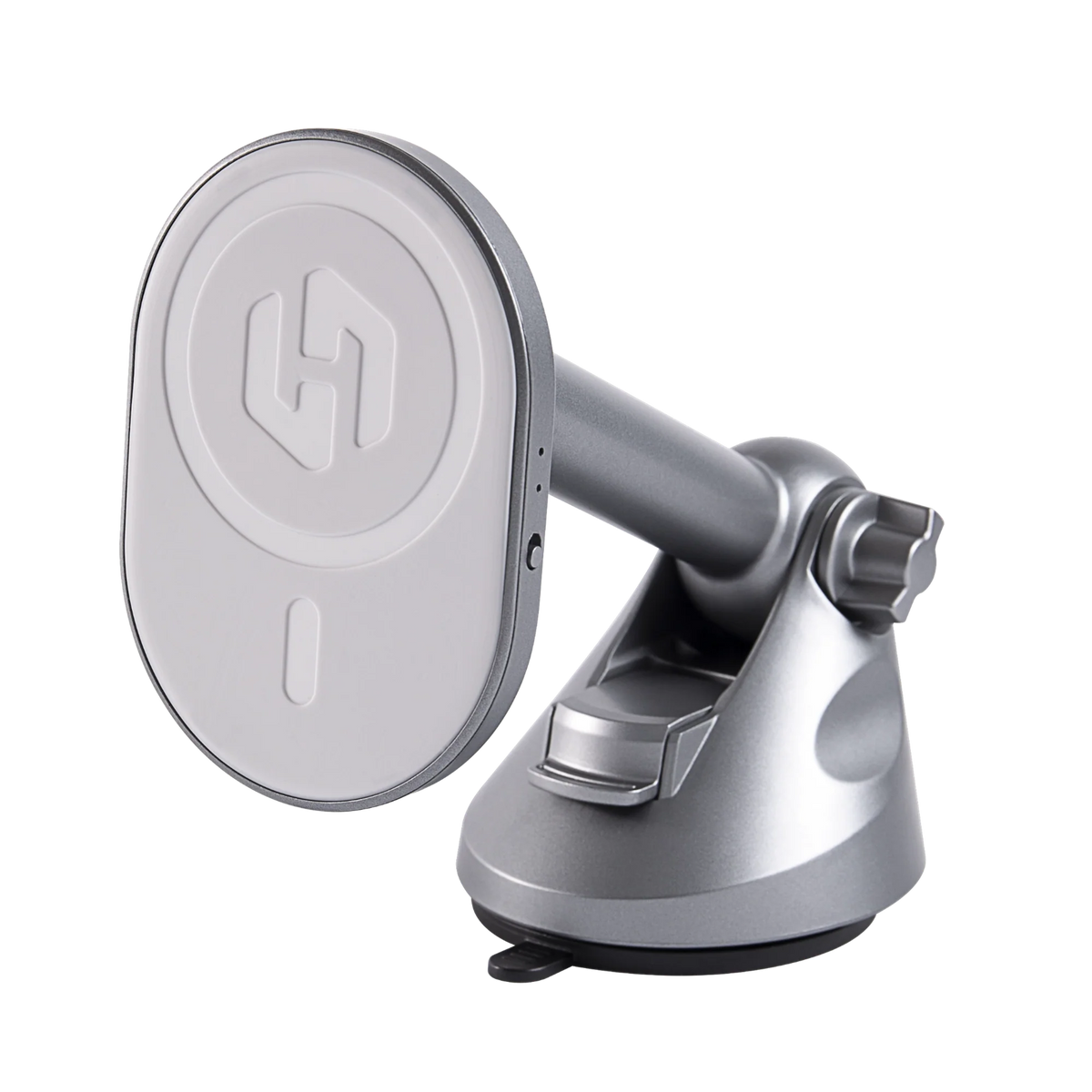
Where you put a MagSafe car mount changes more than you might expect: how stable your phone is on rough roads, whether wireless charging works reliably, and — in the UK and much of Europe — whether your setup is even legal. Here is an honest comparison of the three main positions: air vent, dashboard, and windscreen.
Vent mount: discreet and cool, but check your vents
A vent mount clips onto the slats of an air vent, keeping your phone low and close to your existing controls. It has two real advantages. First, it is the most discreet option — nothing stuck to glass or dash, and it leaves no trace when removed. Second, in warm weather the air conditioning blows directly behind your phone, which matters for wireless charging: phones reduce or pause charging when they get hot, so cool airflow keeps a MagSafe charger like the HexaCharge Complete Kit delivering full power on long summer drives.
The trade-offs: round or weak vent slats (common in some newer cabin designs) may not grip firmly, and in winter the same vent blows hot air at your phone — worth angling the vent away while charging. A quick self-test before committing: clip the mount on, hang your phone, and tap it firmly. If the whole assembly droops or rattles, your vents are not a good match and a dash mount will serve you better.

Dash mount: the most stable all-rounder
A dashboard mount attaches with an adhesive or suction base and holds your phone at a natural eye-adjacent height without touching the windscreen. For most drivers this is the best balance: it is rock-solid on rough roads, works regardless of your vent design, and keeps the phone out of the windscreen's legally protected zones entirely. A telescopic arm such as the HexaDash dash mount lets you pull the phone closer or push it flatter against the dash, which is especially useful in right-hand-drive cars — we covered ideal RHD positioning in detail in our right-hand-drive mounting guide.
Two cautions. Heavily textured or leather-look dashboards reduce adhesive grip, so clean the surface and press the base on firmly and let the adhesive cure for a full day before loading it. And never mount anything on or directly above a passenger airbag cover — check your handbook for where the airbags deploy.

Windscreen mount: convenient, but legally the riskiest
Suction-cup windscreen mounts put the phone closest to your line of sight, which is why sat-navs traditionally lived there. But in the UK, this is where the law bites. The Road Vehicles (Construction and Use) Regulations 1986 require a full view of the road ahead, and Department for Transport guidance divides the windscreen into two zones: Zone A, a 290 mm-wide strip centred on the steering wheel, where an obstruction may encroach no more than 10 mm, and Zone B, the rest of the swept area, where the limit is 40 mm. A modern phone is far wider than either limit, so a phone mounted mid-windscreen in front of the driver is very hard to justify legally. If you use a windscreen mount at all, place it low and far to the passenger side, outside the wiper's swept area — and if any of the road view is blocked from your seat, move it.
Remember that the mount's legality is separate from phone use: touching a handheld phone while driving carries a £200 fixed penalty and six points in the UK. A mounted phone running CarPlay or Android Auto keeps you on the right side of that rule — and a wireless setup means you never handle the phone to plug it in. If your car only supports wired CarPlay, our guide to adding wireless CarPlay to a wired-only car explains the one-time adapter setup.
So which position should you choose?
For most drivers: dash first, vent second, windscreen only with care. A dash mount avoids the windscreen rules completely and stays stable; a vent mount wins if you want zero visual footprint and have sturdy horizontal slats; a windscreen mount is best reserved for cars where neither alternative works, positioned low and out of the swept area. Elsewhere in Europe the details differ by country, but the principle is the same nearly everywhere: the driver's view must not be obstructed, so a dash or vent position is the safer default wherever you drive.
The HexaCharge Complete Kit includes a vent clip, and the HexaDash adds the telescopic dash option, so you can try both positions in your own car and keep whichever suits it. Both ship worldwide with free shipping and duties paid. Unsure whether your car works with wireless CarPlay in the first place? Run it through our compatibility checker in under a minute.
Share:
How to Add Wireless CarPlay to a Wired-Only Car
Wireless Android Auto Adapter: Requirements, Setup & Fixes